Optimal health: for all athletes! Part 4 Mechanisms

As described in previous blogs, the female athlete triad (disordered eating, amenorrhoea, low bone mineral density) is part of Relative Energy Deficiency in sports (RED-S). RED-S has multi-system effects and can affect both female and male athletes together with young athletes. The fundamental issue is a mismatch of energy availability and energy expenditure through exercise training. As described in previous blogs this situation leads to a range of adverse effects on both health and sports performance. I have tried to unravel the mechanisms involved. Please note the diagram below is simplified view: I have only included selected major neuroendocrine control systems.
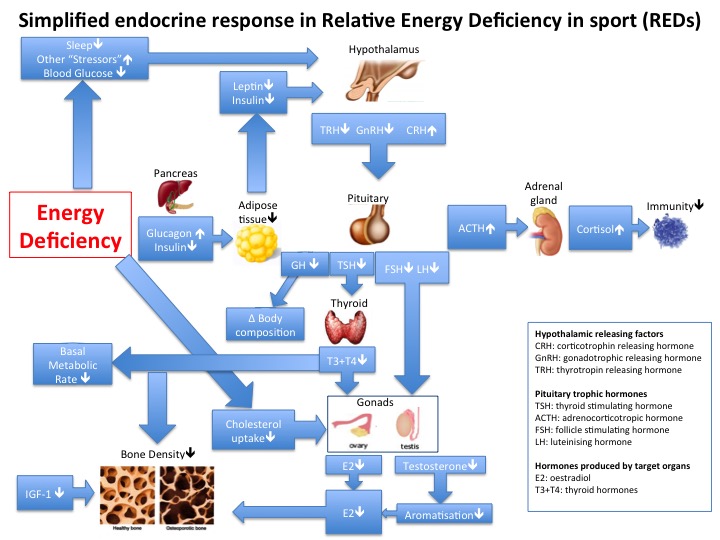
REDs

Low energy availability is an example of a metabolic stressor. Other sources of stress in an athlete will be training load and possibly inadequate sleep. These physiological and psychological stressors input into the neuroendocrine system via the hypothalamus. Low plasma glucose concentrations stimulates release of glucagon and suppression of the antagonist hormone insulin from the pancreas. This causes mobilisation of glycogen stores and fat deposits. Feedback of this metabolic situation to the hypothalamus, in the short term is via low blood glucose and insulin levels and in longer term via low levels of leptin from reduced fat reserves.

A critical body weight and threshold body fat percentage was proposed as a requirement for menarche and subsequent regular menstruation by Rose Frisch in 1984. To explain the mechanism behind this observation, a peptide hormone leptin is secreted by adipose tissue which acts on the hypothalamus. Leptin is one of the hormones responsible for enabling the episodic, pulsatile release of gonadotrophin releasing hormone (GnRH) which is key in the onset of puberty, menarche in girls and subsequent menstrual cycles. In my 3 year longitudinal study of 87 pre and post-pubertal girls, those in the Ballet stream had lowest body fat and leptin levels associated with delayed menarche and low bone mineral density (BMD) compared to musical theatre and control girls. Other elements of body composition also play a part as athletes tend to have higher lean mass to fat mass ratio than non-active population and energy intake of 45 KCal/Kg lean mass is thought to be required for regular menstruation.

Suppression of GnRH pulsatility, results in low secretion rates of pituitary trophic factors LH and FSH which are responsible for regulation of sex steroid production by the gonads. In the case of females this manifests as menstrual disruption with associated anovulation resulting in low levels of oestradiol. In males this suppression of the hypothamlamic-pituitary-gonadal axis results in low testosterone production. In males testosterone is aromatised to oestradiol which acts on bone to stimulate bone mineralisation. Low energy availability is an independent factor of impaired bone health due to decreased insulin like growth factor 1 (IGF-1) concentrations. Low body weight was found to be an independent predictor of BMD in my study of 57 retired pre-menopausal professional dancers. Hence low BMD is seen in both male and female athletes with RED-S. Low age matched BMD in athletes is of concern as this increases risk of stress fracture.  In long term suboptimal BMD is irrecoverable even if normal function of hypothamlamic-pituitary-gonadal function is restored, as demonstrated in my study of retired professional dancers. In young athletes RED-S could result in suboptimal peak bone mass (PBM) and associated impaired bone microstructure. Not an ideal situation if RED-S continues into adulthood.

Another consequence of metabolic, physiological and psychological stressor input to the hypothalamus is suppression of the secretion of thyroid hormones, including the tissue conversion of T4 to the more active T3. Athletes may display a variation of “non-thyroidal illness/sick euthyroid” where both TSH and T4 and T3 are in low normal range. Thyroid hormone receptors are expressed in virtually all tissues which explains the extensive effects of suboptimal levels of T4 and T3 in RED-S including on physiology and metabolism.

In contrast, a neuroendocrine control axis that is activated in RED-S is the hypothalamic-pituitary-adrenal axis. In this axis, stressors increase the amplitude of the pulsatile secretion of CRH, which in turn increases the release of ACTH and consequently cortisol secretion from the adrenal cortex. Elevated cortisol suppresses immunity and increases risk of infection. Long term cortisol elevation also impairs the other hormone axes: growth hormone, thyroid and reproductive. In other words the stress response in RED-S amplifies the suppression of key hormones both directly and indirectly via endocrine network interactions.

The original female athlete triad is part of RED-S which can involve male and female athletes of all ages. There are a range of interacting endocrine systems responsible for the multi-system effects seen in RED-S. These effects can impact on current and future health and sports performance.

For further discussion on Endocrine and Metabolic aspects of SEM come to the BASEM annual conference 22/3/18: Health, Hormones and Human Performance

References

Teaching module on RED-S for BASEM as CPD for Sports Physicians

Optimal health: including female athletes! Part 1 Bones Dr N. Keay, British Journal of Sport Medicine

Optimal health: including male athletes! Part 2 Relative Energy Deficiency in sports Dr N.Keay, British Journal of Sport Medicine 4/4/17

Optimal health: especially young athletes! Part 3 Consequences of Relative Energy Deficiency in sports Dr N. Keay, British Association of Sport and Exercise Medicine

Keay N, Fogelman I, Blake G. Effects of dance training on development,endocrine status and bone mineral density in young girls. Current Research in Osteoporosis and bone mineral measurement 103, June 1998.

Jenkins P, Taylor L, Keay N. Decreased serum leptin levels in females dancers are affected by menstrual status. Annual Meeting of the Endocrine Society. June 1998.

Keay N, Dancing through adolescence. Editorial, British Journal of Sports Medicine, vol 32 no 3 196-7, September 1998.

Keay N, Effects of dance training on development, endocrine status and bone mineral density in young girls, Journal of Endocrinology, November 1997, vol 155, OC15.

Relative Energy Deficiency in sport (REDs) Lecture by Professor Jorum Sundgot-Borgen, IOC working group on female athlete triad and IOC working group on body composition, health and performance. BAEM Spring Conference 2015.

Mountjoy M, Sundgot-Borgen J, Burke L, Carter S, Constantini N, Lebrun C, Meyer N, Sherman R, Steffen K, Budgett R, Ljungqvist A. The IOC consensus statement: beyond the Female Athlete Triad-Relative Energy Deficiency in Sport (RED-S).Br J Sports Med. 2014 Apr;48(7):491-7.

“Subclinical hypothydroidism in athletes”. Lecture by Dr Kristeien Boelaert at BASEM Spring Conference 2014 on the Fatigued Athlete

From population based norms to personalised medicine: Health, Fitness, Sports Performance Dr N. Keay, British Journal of Sport Medicine
Optimal health: especially young athletes! Part 3 Consequences of Relative Energy Deficiency in sports

In my previous blogs I have described the adverse effects of Relative Energy Deficiency in sports (RED-S) in both female and male athletes both in terms of current health and sport performance and potential long term health problems. What about young aspiring athletes? There is concern that early sport specialisation, imbalances in training not covering the full range of the components of fitness, together with reduced sleep, all combine to increase injury risk. Young athletes are particularly vulnerable to developing RED-S during a period of growth and development accompanied by a high training load.

Sufficient energy availability and diet quality, including micronutrients, is especially important in young athletes. To investigate further I undertook a three year longitudinal study involving 87 pre- and post-pubertal girls, spread across control pupils at day school together with students in vocational training in both musical theatre and ballet streams. There was a gradation in hours of physical exercise training per week ranging from controls with least, followed by musical theatre, through to ballet stream with the most.

In all girls dietary, training and menstrual history were recorded and collected every six months. At the same visit anthropometric measurements were performed by an experienced Paediatric nurse and bloods were taken for Endocrine markers of bone metabolism and leptin. Annual DEXA scans measured body composition, total body bone mineral density (BMD) and BMD at lumbar spine (including volumetric) and BMD at femoral neck.

The key findings included a correlation between hours of training and the age of menarche and subsequent frequency of periods. In turn, any menstrual dysfunction was associated with low age-matched (Z score) BMD at the lumbar spine. There were significant differences between groups for age-matched (Z score) of BMD at lumbar spine, with musical theatre students having the highest and ballet students the lowest. There were no significant differences in dietary intake between the three groups of students, yet the energy expenditure from training would be very different. In other words, if there is balance between energy availability and energy expenditure from training, resulting in concurrent normal menstrual function, then such a level of exercise has a beneficial effect on BMD accrual in young athletes, as demonstrated in musical theatre students. Conversely if there is a mismatch between energy intake and output due to high training volume, this leads to menstrual dysfunction, which in turn adversely impacts BMD accrual, as shown in the ballet students.

I was fortunate to have two sets of identical twins in my study. One girl in each twin pair in the ballet stream at vocational school had a twin at a non-dance school. So in each twin set, there would be identical genetic programming for age of menarche and accumulation of peak bone mass (PBM). However the environmental influence of training had the dominant effect, as shown by a much later age of menarche and decreased final BMD at the lumbar spine in the ballet dancing girl in each identical twin pair.

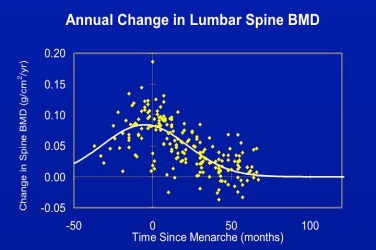
After stratification for months either side of menarche, the peak rate of change for BMD at the lumbar spine was found to be just before menarche, declining rapidly to no change by 60 months post menarche. These findings suggest that optimal PBM and hence optimal adult BMD would not be attained if menarche is delayed due to environmental factors such as low energy density diet. If young athletes such as these go on to enter professional companies, or become professional athletes then optimal, age-matched BMD may never be attained as continued low energy density diet and menstrual dysfunction associated with RED-S may persist. Associated low levels of vital hormones such as insulin like growth factor 1 (IGF-1) and sex steroids impair bone microarchitecture and mineralisation. Thus increasing risk of injury such as stress fracture and other long term health problems. The crucial importance of attaining peak potential during childhood and puberty was described at a recent conference at the Royal Society of Medicine based on life course studies. For example, delay in puberty results in 20% reduction of bone mass.

Graph from study of dancers (Keay et al) showing change in BMD according to time from menarche

slide10

It is concerning that RED-S continues to occur in young athletes, with potential current and long term adverse consequences for health. Young people should certainly be encouraged to exercise but with guidance to avoid any potential pitfalls where at all possible. In my next blog I will delve into the Endocrine mechanisms involved in RED-S: the aetiology and the outcomes.

For further discussion on Endocrine and Metabolic aspects of SEM come to the BASEM annual conference 22/3/18: Health, Hormones and Human Performance

References

Optimal Health: including female athletes! Part 1 Bones Dr N. Keay, British Journal of Sport Medicine

Optimal health: including male athletes! Part 2 Relative Energy Deficiency in sports Dr N. Keay, British Journal of Sport Medicine 4/4/17

Keay N. The modifiable factors affecting bone mineral accumulation in girls: the paradoxical effect of exercise on bone. Nutrition Bulletin 2000, vol 25, no 3. 219-222.

Keay N The effects of exercise training on bone mineral accumulation in adolescent girls. Journal of Bone and Mineral Research. Vol 15, suppl 1 2000.

Keay N, Frost M, Blake G, Patel R, Fogelman I. Study of the factors influencing the accumulation of bone mineral density in girls. Osteoporosis International. 2000 vol 11, suppl 1. S31.

New S, Samuel A, Lowe S, Keay N. Nutrient intake and bone health in ballet dancers and healthy age matched controls: preliminary findings from a longitudinal study on peak bone mass development in adolescent females, Proceedings of the Nutrition Society, 1998

Keay N, Dancing through adolescence. Editorial, British Journal of Sports Medicine, vol 32 no 3 196-7, September 1998.

Bone health and fractures in children. National Osteoporosis Society

Lifetime influences on musculoskeletal ageing and body composition. Lecture by Professor Diana Kuh, Director of MRC Unit for Lifelong Healthy Ageing, at Royal Society of Medicine, conference on Sports Injuries and sports orthopaedics. 17/1/17

Relative Energy Deficiency in sport (REDs) Lecture by Professor Jorum Sundgot-Borgen, IOC working group on female athlete triad and IOC working group on body composition, health and performance. BAEM Spring Conference 2015.

Health and fitness in young people

Optimal health: including male athletes! Part 2 Relative Energy Deficiency in sports

Screen Shot 2018-02-25 at 16.51.20

As discussed in my previous blog Optimal health: including female athletes! Part 1 Bones, the female athlete triad is well described since 1984. The triad comprises disordered eating, amenorrhoea and reduced bone mineral density (BMD). What was uncertain was whether this was a reversible training effect. My study of professional retired pre-menopausal female dancers demonstrated that such bone loss is irreversible, despite resumption of menses. Furthermore, low body weight, independent of amenorrhoea, causes BMD loss. A few female athletes in my subsequent longitudinal study of professional dancers in the English National Ballet company were “robust” and continued to menstruate, in spite of low body weight. However this could have involved anovulatory cycles and therefore low oestrogen. One parameter cannot be considered in isolation.

Furthermore, it has become apparent that the female athlete triad is just part of a much larger picture, known as Relative Energy Deficiency in sport (RED-S). The fundamental issue is that of energy deficiency caused by a mismatch of energy intake and energy expenditure from exercise training. Quality of diet, including micronutrients is also important.

If you are a male athlete, you may be thinking that this is all just a problem for female counterparts? No. Male athletes can also develop RED-S, especially in sports where low body weight confers a sport performance advantage, for example long-distance runners and road cyclists (especially climbers). In a fascinating lecture, Professor Jorum Sundgot-Borgen from the Department of Sport Medicine, at the Norwegian School of Sport and Exercise Science, described the occurrence in male ski jumpers.

This energy deficient state in RED-S in both female and male athletes produces a cascade, network effect on multiple systems: immune, cardiovascular, endocrine, metabolic and haematological effects. Clearly suboptimal functioning in these key areas has implications for current physical and psychological health of athletes and therefore their sport performance. The psychological element is of note as this may be both cause and effect of RED-S. After all in order to be a successful, especially in sport, a high level of motivation, bordering on obsession, is required. Although athletes with RED-S may not fall into a defined clinical disease state, they demonstrate a subclinical condition that impacts health. Performance implications include decreased training response with reduced endurance, muscle strength and glycogen storage, alongside an increased risk of injury, probably due to impaired adaptive response to training and a decrease in co-ordination and concentration. Psychological sequelae include depression and irritability.

Some features of RED-S may be lead to irreversible health issues in the future, as seen in the case of athletic hypothalamic amenorrhoea in female athletes with permanent loss of BMD. In both male and female athletes low energy density diet relative to energy expenditure with training results in low levels of insulin like growth factor 1 (IGF-1) and sex steroid hormones which impair not only sport performance but bone microarchitecture and mineralisation. Although hypothalamic suppression in females is manifest by lack of menstruation, there is no such obvious clinical sign in males, who may nevertheless also be experiencing suppression of the hypothalamic-pituitary-gonadal axis. It has been shown that oestradiol is the key sex steroid hormone in promoting bone mineralisation: for both male and female. In males testosterone is aromatised to oestradiol which in turn acts on bone. As the same mechanisms are involved in the aetiology and effects of RED-S, then the long term consequences will most likely be the same for both female and male athletes.

In my next blog I will explore the consequences of RED-S in young athletes and delve into the Endocrine mechanisms involved in the aetiology and multi-system outcomes for male and female athletes of all ages.

For further discussion on Endocrine and Metabolic aspects of SEM come to the BASEM annual conference 22/3/18: Health, Hormones and Human Performance

References

Optimal health: including female athletes! Part 1 Bones Dr N.Keay, British Journal of Sport Medicine

Keay N, Fogelman I, Blake G. Bone mineral density in professional female dancers. British Journal of Sports Medicine, vol 31 no2, 143-7, June 1997.

From population based norms to personalised medicine: Health, Fitness, Sports Performance Dr N. Keay, British Journal of Sport Medicine

Relative Energy Deficiency in sport (REDs) Lecture by Professor Jorum Sundgot-Borgen, IOC working group on female athlete triad and IOC working group on body composition, health and performance. BAEM Spring Conference 2015.

Mountjoy M, Sundgot-Borgen J, Burke L, Carter S, Constantini N, Lebrun C, Meyer N, Sherman R, Steffen K, Budgett R, Ljungqvist A. The IOC consensus statement: beyond the Female Athlete Triad-Relative Energy Deficiency in Sport (RED-S).Br J Sports Med. 2014 Apr;48(7):491-7.

Margo Mountjoy, IOC Medical Commission Games Group. Relative Energy Deficiency in Sport. Aspetar Sports Medicine Journal.

From population based norms to personalised medicine: Health, Fitness, Sports Performance

animation

“Health is a state of complete physical, mental and social well-being and not merely the absence of disease or infirmity”. World Health Organisation 1948

There has been criticism of this definition, arguing that the word “complete” has opened the door to today’s more medicalised society. However, this trend coincides with increased volume of “patients” seeking optimal health, together with doctors who have a more extensive repertoire of medical interventions at their disposal. In a time-pressed society there is less opportunity for either patient or doctor to explore longer term adaptive measures and prevention strategies, which facilitate taking responsibility for your health. Fortunately Sport and Exercise Medicine became a recognised medical specialty in the UK in 2006. This encompasses population-based strategies for disease prevention outlined in the global initiative founded in 2007 “Exercise is Medicine“.

What has this got to do with sports performance? There are subgroups within the population, such as athletes already taking plenty of exercise. Elite athletes differ from the general population, due to superior adaptation processes to exercise, probably with a genetic component. So are the same “normal” population-based ranges of quantified medical parameters applicable?

This is precisely the issue that arose when I was on the international medical research team investigating the development of a dope test for growth hormone (GH). Crucially, exercise is one of the major stimuli for growth hormone release from the anterior pituitary. So before we could even start investigating potential downstream markers of exogenous GH abuse, the “normal” range for elite athletes had to be established.

In a similar way, are the “normal” ranges for other hormones applicable to athletes? In a fascinating lecture delivered by Dr Kristien Boelaert, Consultant Endocrinologist, it was explained that the distribution for thyroid stimulating hormone (TSH) is affected by multiple factors, including illness, age and exercise status. So “normal” for the general population is not necessarily normal for specific subgroups.

The other issue, especially with the Endocrine system is that hormones act on a variety of tissues and so produce a variety of multi-system network effects with interactions and control feedback loops. Therefore symptoms of malfunction/maladaptation and subclinical conditions can be non specific. From a doctor’s perspective this makes Endocrinology fascinating detective work, but challenging when dealing with subgroups in the population who require a more intensive work-up and individualised approach.

larf5523

The vast majority of research studies involve exclusively male athletes, leaving female athletes under-represented (a recent study on heat adaptation in female athletes being a notable exception). Some areas of research, including my own, have been directed more towards female athletes in the case of female athlete triad, or Relative Energy Deficiency in sports (REDs). REDs is a more appropriate term as it really sums up the important points: male and female can both be affected and therefore should both be studied. There are subgroups within the general population who may not fit the “normal” range: REDs is not necessarily a clinically defined eating disorder from lecture by Professor J. Sundgot-Borgen (IOC working group on female athlete triad and IOC working group on body composition, health and performance).

No medical/physiological/metabolic parameter can be considered in isolation: in the case of REDs, it is not menstrual disturbance and bone health that are affected in isolation. For example, there is currently great debate about whether a low carbohydrate/high fat diet (ketogenic diet) can mobilise fat oxidation and potentially be a training strategy to enhance performance. Needless to say that a recent study contained no female athletes. Given that many female endurance athletes are already lean, potentially driving fat metabolism through diet manipulation may have an impact on Endocrine function, optimal health and hence sport performance. I understand that a forthcoming study will include female athletes.

So a continuum or distinct subgroups in the population? Clearly general medical principles apply to all, with a spectrum from optimal functioning, subclinical conditions through to recognised disease state. We now have evidence of distinct differences between subgroups in the population and even within these subgroups such as male and female athletes. We are moving into a world of personalised medicine, where recommendations for optimal health are tailored for individuals within specific subgroups.

For further discussion on Endocrine and Metabolic aspects of SEM come to the BASEM annual conference 22/3/18: Health, Hormones and Human Performance

References

How should we define health?

Nobody is average but what to do about it? The challenge of individualized disease prevention based on genomics

Exercise is Medicine

Enhancing Sport Performance: part 1

Keay N, Logobardi S, Ehrnborg C, Cittadini A, Rosen T, Healy ML, Dall R, Bassett E, Pentecost C, Powrie J, Boroujerdi M, Jorgensen JOL, Sacca L. Growth hormone (GH) effects on bone and collagen turnover in healthy adults and its potential as a marker of GH abuse in sport: a double blind, placebo controlled study. Journal of Endocrinology and Metabolism. 85 (4) 1505-1512. 2000.

Wallace J, Cuneo R, Keay N, Sonksen P. Responses of markers of bone and collagen turover to exercise, growth hormone (GH) administration and GH withdrawal in trained adult males. Journal of Endocrinology and Metabolism 2000. 85 (1): 124-33.

Wallace J, Cuneo R, Baxter R, Orskov H, Keay N, Sonksen P. Responses of the growth hormone (GH) and insulin-like factor axis to exercise,GH administration and GH withdrawal in trained adult males: a potential test for GH abuse in sport. Journal of Endocrinology and Metabolism 1999. 84 (10): 3591-601.

Keay N, Logobardi S, Ehrnborg C, Cittadini A, Rosen T, Healy ML, Dall R, Bassett E, Pentecost C, Powrie J, Boroujerdi M, Jorgensen JOL, Sacca L. Growth hormone (GH) effects on bone and collagen turnover in healthy adults and its potential usefulness as in the detection of GH abuse in sport: a double blind, placebo controlled study. Endocrine Society Conference 1999.

Wallace J, Cuneo R, Keay N. Bone markers and growth hormone abuse in athletes. Growth hormone and IGF Research, vol 8: 4: 348.

Cuneo R, Wallace J, Keay N. Use of bone markers to detect growth hormone abuse in sport. Proceedings of Annual Scientific Meeting, Endocrine Society of Australia. August 1998, vol 41, p55.

Subclinical hypothydroidism in athletes. Lecture by Dr Kristeien Boelaert at BASEM Spring Conference 2014 on the Fatigued Athlete

Optimal health: especially young athletes! Part 3 Consequences of Relative Energy Deficiency in sports Dr N.Keay, British Association Sport and exercise Medicine

Optimal health: including female athletes! Part 1 Bones Dr N. Keay, British Journal of Sport Medicine

Relative Energy Deficiency in sport (REDs) Lecture by Professor Jorum Sundgot-Borgen, BAEM Spring Conference 2015 on the Female Athlete

Effect of adaptive responses to heat exposure on exercise performance

Low Carbohydrate, High Fat diet impairs exercise economy and negates the performance benefit from intensified training in elite race walkers

Enhancing Sports Performance: part 3

Amateur and recreational athletes

Recently the World Anti-Doping Agency WADA released details for the 2017 Prohibited List, which will come into effect on 1 January 2017. If you have read part 1 and part 2 of this series of blogs, you might be thinking that illegal doping to enhance sports performance is only of relevance to elite sport. Equally that the discussion of TUEs is only related to elite athletes. Well this blog will explore whether that is the case…

I am writing from a medical perspective based on my experience of working on the international medical research team that investigated the development of dope test for growth hormone GH, supported by the IOC.

The list issued by UK Anti-Doping UKAD of athletes banned from competition due to taking illegal performance enhancing drugs dispels the assumption that doping is confined to elite athletes. Indeed it is concerning that the list is substantial and includes a range of athletes from teenagers to age groupers across a variety of sports. Consider that this only shows results from sports where drug testing takes place.

As discussed in a recent article in British Medical Journal BMJ, there are an estimated 3 million anabolic steroid users in Europe alone. These users may not necessarily be involved in sports where drug testing takes place. From a medical point of view there is the concern of long term, irreversible adverse effects on health: cardiac, hepatic, psychiatric and reproductive complications.

Although professional dance can be viewed as an art form, rather than a sport, the increased technical requirements together with extended rehearsal and performance schedules place high physical and psychological demands on dancers, similar to elite athletes. In a recent article in the Dance Gazette there is discussion of “performance enhancement in dance being more about survival than competitive edge”.  Unlike sport, in classical dance there is a difference between female dancers who might dope in order to reduce body weight and male dancers looking for means to improve muscle strength.

The show must go on but the aim should be to strive for clean sport and to safeguard the health of athletes.

For further discussion on Endocrine and Metabolic aspects of SEM come to the BASEM annual conference 22/3/18: Health, Hormones and Human Performance

References

Enhancing sport performance: part 1 British Association of Sport and Exercise Medicine

Enabling Sport Performance: part 2

WADA

UKAD

BMJ 2016;353:i5023

Dance Gazette issue 3 2016 p.50-53

Ballet for Injury Prevention


Ballet is an excellent way for people of all ages to improve mobility and build strength.

g0010105
Barnes Studio

Furthermore, if athletes take Ballet classes then this can aid in injury prevention. Ballet incorporates all the elements of a balanced training session improving core strength, muscle tone, muscle dynamics, flexibility, neuromuscular skills and proprioception. Taking Ballet class also provides an interesting challenge both mentally and physically as described in amina sana corpore sano. Ballet offers something different to the usual strength and conditioning training sessions taken by athletes.

Development of neuromuscular skills is vital for young people not only for physical fitness and enabling sports performance, but to enhance cognitive ability, both in short and long term.

The American Academy of Orthopaedic Surgeons recommend that if you are tempted to try Ballet, make sure you go to a class where the teacher can ensure you learn proper technique. I teach Ballet, backed up with my experience in sport medicine and Pilates, in small class setting for individual attention and correction. Whatever your previous dance experience or current level of fitness: are you ready for the challenge and some fun?

For further discussion on Endocrine and Metabolic aspects of SEM come to the BASEM annual conference 22/3/18: Health, Hormones and Human Performance

References

Ballet

Stories

Anima sana corpore sano

Young people: neuromuscular skills for sports performance

AAOS