What has your gut microbiome ever done for you?

a-muciniphila-233x300

Our body acts as a host to vast array of micro-organisms. Often, we are only aware of these micro-organisms causing unwanted infection: for example when a cut on the skin becomes infected, or we suffer with a bout of infective gastro-intestinal upset. Actually, this perception of the micro-organisms, living both on and inside, only causing unwanted infections is very biased. The microbiome (all the micro-organisms, their genetic material and metabolites produced) plays a vital role in keeping us healthy.

Recent research demonstrates that elite level cyclists host distinct clusters of microbiome communities when compared to controls which contribute to more effective metabolic pathways.

The gut microbiota consist of the range of micro-organisms living in our gut, mainly the colon. Recent research reveals that the diversity and functions of the gut microbiota have far reaching impact on health. For example, there is an important interaction between these micro-organisms and mitochondria, which are the organelles in cells responsible for producing energy. This cross talk is of particular consideration for athletes who seek to optimise energy production for training and competition. The gut microbiota also interact with the immune system and central nervous system function, including behaviour. There is evidence that the gut microbiota even influences brain development.

Microbiome Mitochondria Feedback

On the other side of the coin, any disruption in the beneficial types of gut microbiota have been linked to chronic disease states including obesity, metabolic syndrome and mental health issues. What causes imbalances in gut microbiota to produce such problems? A possible aetiology is a poorly balanced diet, or the side effect of medication which does not support the growth and function of beneficial bacteria. Rather an overgrowth of potentially harmful bacteria is favoured: dysbiosis. In athletes there is a condition know as “leaky gut” which can result from endurance training. In this scenario, blood is diverted away from the gut during exercise to the exercising muscles. After stopping exercise, blood flow is restored to the gut resulting in a mild reperfusion injury. This results in a slightly “leaky gut” so that unwanted bacteria in the gut are able to pass into the body and provoke an inflammatory response. Equally this situation can also mean desirable nutrients in the gut as less well absorbed. Although a degree of inflammatory response supports desirable adaptations to exercise, clearly an over-response will be counter productive to improving sports performance.

The gut microbiota have been reported to regulate immune function. Athletes in heavy training can experience suppressed functional immunity so any strategies to support the gut microbiota will potentially be beneficial in preventing infection.

What can you do to support a beneficial gut microbiota to support health and sport performance?

  • Try to include at least one fermented food source in your diet every day to boost your probiotic bacteria. Try sourdough bread, yogurt, kefir (similar to yogurt), sauerkraut, kimchi (Korean fermented vegetables), tempeh and miso (fermented soya products) and kombucha (fermented teas). These products can be found in health food shops and are becoming more widely available in some supermarkets and lunch places.
  • Regularly eat pre-biotic foods like garlic, onion, leeks, chickpeas, beans and lentils. These provide fuel for your probiotic bacteria, enabling them to proliferate.
  • Have adequate fibre in your diet from a wide variety of plant foods: eg wholegrains, legumes, vegetables, fruits, nuts, seeds. Dietary fibre is fermented by your probiotic bacteria to produce short chain fatty acids (SCFAs) which play a key role in keeping your gut healthy.
  • Consume foods and drinks rich in polyphenols: eg berries, green tea, coffee, black tea, red wine, dark chocolate, apples. Polyphenols, found in many plant foods, have been shown to help increase probiotic bacteria in the gut.
  • Take a good quality, multi-species probiotic supplement during winter, heavy training blocks and when travelling abroad, especially for races. To find out more about the potential benefits of probiotic supplementation for athletes, see this blog by nutritional therapist Jo Scott-Dalgleish: http://www.endurancesportsnutritionist.co.uk/blog/probiotics-guide-endurance-athlete/

To find out more about the interaction between Health, Hormones and Human Performance come to the British Association of Sport and Exercise Medicine annual conference

References

Community characteristics of the gut microbiomes of competitive cyclists Microbiome August 2017

Ubiquitous Microbiome: impact on health, sport performance and disease

Endocrine system: balance and interplay in response to exercise training

Inflammation: Why and How Much? Dr N. Keay, British Association of Sport and Exercise Medicine 2017
Medically young, older athletes

Spot the differences?

Screen Shot 2017-04-05 at 14.22.03

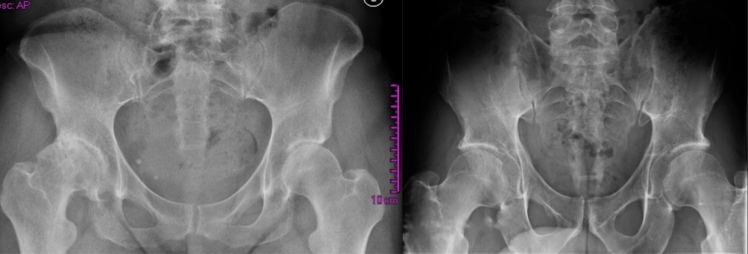
You don’t have to be a Radiologist to see that there are some differences between the two X-rays above. Both are from adults of the same age 51 years. Female on left as you look at screen and male on right. In both cases, these adults would be described as “medically young”. Always physically active and reasonably accomplished as athletes in their respective sport disciplines. Never smoked, never overweight, good nutrition.

As discussed at the recent conference at the Royal Society of Medicine (RSM) on “Sports Injuries and Sports Orthopaedics” in the session on the “Ageing Athlete”, there are challenges for athletes in Masters’ age groups, including mechanical joint issues associated with increasing age.

Looking at the male X-ray on right there is small gap between femoral head (ball-like structure) and acetabulum (socket in which femoral head lies). This gap is where the articular cartilage reduces friction between articulating surfaces of this ball and socket joint. In contrast in female X-ray on left of screen, this gap is reduced as cartilage has been worn away so that on right hip (left as you look at screen) bone is grinding on bone. Ouch!

Look again at the femoral heads (ball like structures). In the male these have smooth contours and are symmetrical on both sides. In contrast, in the female there is marked asymmetry with squashed appearance on right side (left of screen) of the femoral head with honeycomb appearance suggesting that there is cyst formation and impaction into socket of joint. This results in shorter leg and weakness of the bone architecture so more likely to compress further. Strangely the blood supply to femoral head is retrograde, meaning it flows backwards from origin of supplying blood vessel to provide vital nutrients to bone, which is a living tissue. If this blood supply is disrupted then the bone dies (avascular necrosis) and become more fragile. The femoral neck (slim area below femoral head) where blood supply courses, has been telescoped down and looks stubby compared to opposite side in female.

Although in the female, the right hip aches and is stiff, it is actually the left hip (right as you look at screen) that hurts more, both at rest and when trying to exercise. Why? If you look carefully on the upper boarder of acetabulum (socket) you will see small cysts. I imagine that pain is caused when the synovial fluid (lubricating fluid) in joint is forced into exposed bone, in hydraulic action especially when moving the hip joint.

So what to do? Total hip replacement (THR) is the only feasible option for the female above, due to extensive damage to the hip joints. Why are some people more prone to this type of joint damage? Apart from underlying medical pathologies that damage joints, the nature of some types of exercise can contribute. For example Ballet is demanding on the hip joint in terms of range of movement and load bearing. The individual can also be predisposed in biomechanical terms to joint issues: in the female X-ray above the femoral head is more exposed than the male.

Although the perception is that THR is more for the elderly wishing to be able to walk to the shops, with improvements in materials and technology used in hip protheses, there are examples of young athletes successfully returning to previous pre-operative levels of exercise training without pain. Recently a 28 year old male soloist dancer of the Paris Opera Ballet had a THR and returned to professional dancing. The medically young athlete will probably have the required motivation and physical ability to rehab effectively. A house in the south of France with private pool and climate for rehab outside would certainly add to motivation. Nevertheless, return to dancing at a professional level in a top level Ballet company after THR is remarkable as classical dance requires a unique combination of outstanding strength, control, proprioception and flexibility. At the conference at the RSM, during the lecture on “Can I run after my hip replacement?” hip replacements in the medically young, active population were reported to have good success rate with athletes able to return to previous level of sport with predicted lifespan of replacement of up to 25 years. Of course every individual athlete should weigh up the pros and cons. Taking up a new impact sport would probably not be sensible. Delaying surgery too long, apart from increasing pain, can compromise biomechanics and therefore replacement outcome. On the other hand, any operation carries a risk, however small and THR requires extensive rehabilitation in order to return to sport.

Deciding on the timing of THR in medically young, older athlete is not straight forward, especially if considering your own hips. Ultimately in such a person, the decision to go for surgery is based on quality of life and limitation to current sport activity, combined with the desire to return to previous level of activity, without the pain. What would you do?

For further discussion on Endocrine and Metabolic aspects of SEM come to the BASEM annual conference 22/3/18: Health, Hormones and Human Performance

References

Successful Ageing Dr N. Keay, British Association of Sport and Exercise Medicine 2017
Conference: Sports Injuries and Sports Orthopaedics, Royal Society of Medicine, 18/1/17, Session “The Ageing athlete”. Including lectures on: “Can I run after my hip replacement? Current recommendations for impact exercise following joint replacement” Mr Konan and “Managing acute injuries in worn joints” Mr Oussedik


Successful Ageing

As I am discovering, ageing is an inevitable process. However what can you do to keep as healthy as possible in order to get the most out of life?

crop Budapest0571

If you are a Masters athlete, you will know that moving into these age groups means it is advisable to change training emphasis in order to prevent injury and compete successfully. As discussed at the recent conference Royal Society of Medicine on Sports Injuries and Sports Orthopaedics, during the session on “The Ageing Athlete”, older athletes need a longer dynamic warm up with controlled mobilisation and muscle activation, together with strength and conditioning sessions to prevent injury. Moving into next age group every five years gives the opportunity to assess and modify training accordingly.

Childhood development has an impact on long term adult health. Essentially the most rapid changes and potential peaks attained during childhood and adolescence reflect optimal physical and cognitive functioning in later life. The evidence from population cohort studies was presented by Professor Diana Kuh, director of MRC Unit for Lifelong Health and Ageing, at the recent conference at the Royal Society of Medicine. Up to 66% of the decline in functional ability in ageing adults is related to childhood development. In the case of pubertal timing, Professor Kuh described that delay causes 20% reduction of volumetric trabecular bone accrual. In my 3 year longitudinal study of 87 pre and post pubertal girls, high levels of training delayed menarche and blunted attainment of peak bone mass (PBM). Conversely an optimal level of training did not delay menarche and improved bone mineral density compared to age marched sedentary controls. A similar long term effect is seen in older female athletes who have experienced amenorrhoea of more than 6 months duration. Even after retirement and resumption of menses pre-menopause, irreversible loss of bone mineral density (BMD) is seen. Professor Kuh argued for specific and personalised recommendations to individuals to support successful ageing.

From a personalised medical perspective, what about hormonal changes associated with ageing? Although in men testosterone levels decline with age, nevertheless the change is more dramatic in women at menopause where the ovaries stop producing oestrogen and progesterone. This results in increased risk after the menopause of osteoporosis, cardiovascular disease and stroke, together with other vasomotor symptoms and mood changes. With increased life expectancy comes an increasing number of women with menopausal symptoms and health issues which can negatively impact on quality of life. What about hormone replacement therapy (HRT)? HRT improves menopausal symptoms and reduces the risk of post menopausal long term health problems, provided HRT is started within ten years after the menopause. After this window of opportunity replacement oestrogen can actually accelerate cell damage. As with any medical treatment there will be those for whom HRT is contra-indicated. Otherwise the risk:benefit ratio for each individual has to be weighed up so that women can arrive at an informed decision. Regarding the risk of breast cancer, this is increased by 4 cases per 1,000 women aged 50-59 years on combined HRT. This compares to an additional 24 cases in women who have body mass index (BMI)>30 and are not on HRT. This underlines the important of lifestyle which is crucial in all areas of preventative medicine.

What type of HRT has the most favourable risk:benefit ratio? Oral preparations undergo first pass metabolism in the liver, so other routes of delivery such as transdermal may be preferred. There is also an argument that hormones with identical molecular structure are preferable to bio-similar hormones. What functional effect could a slight difference in sex steroid structure have? For example no methyl group and a side chain with hydroxyl group (C-OH) rather than a carbonyl group (C=O)? That is the difference between oestradiol and  testosterone.

img_0373
Testosterone
img_0375
Oestradiol

In the case of hormones with identical molecular structure to those produced endogenously, there are no potential unwanted side effects or immunogenic issues as the molecule is identical to that produced by the body. Although the oestradiol component in most HRT preparations in the UK has an identical molecular structure to endogenous oestradiol, there is only one licensed micronised progesterone preparation that has an identical molecular structure. Synthetic, bio-similar (not identical) progestins have additional glucocorticoid and androgenic effects compared to molecular identical progesterone which exerts a mild anti-mineralocorticoid (diuretic) effect.

img_0376
Progesterone
img_0378
Norethisterone (synthetic progestin)

With an increasing ageing population and increase in life expectancy, it is important to support successful ageing and quality of life with a personalised and specific approach.

For further discussion on Endocrine and Metabolic aspects of SEM come to the BASEM annual conference 22/3/18: Health, Hormones and Human Performance

References

Conference Royal Society of Medicine 17/1/17 “Sports Injuries and Sports Orthopaedics” Session on “The Ageing Athlete”

Optimal health: especially young athletes! Part 3 Consequences of Relative Energy Deficiency in sports Dr N. Keay, British Association Sport and Exercise Medicine

From population based norms to personalised medicine: Health, Fitness, Sports Performance Dr N. Keay, British Journal of Sport Medicine 22/2/17

Optimal health: including female athletes! Part 1 Bones Dr N. Keay, British Journal of Sports Medicine

The British Menopause Society

Royal College of Obstetricians and Gynaecologists 

Optimal health: especially young athletes! Part 3 Consequences of Relative Energy Deficiency in sports

In my previous blogs I have described the adverse effects of Relative Energy Deficiency in sports (RED-S) in both female and male athletes both in terms of current health and sport performance and potential long term health problems. What about young aspiring athletes? There is concern that early sport specialisation, imbalances in training not covering the full range of the components of fitness, together with reduced sleep, all combine to increase injury risk. Young athletes are particularly vulnerable to developing RED-S during a period of growth and development accompanied by a high training load.

Sufficient energy availability and diet quality, including micronutrients, is especially important in young athletes. To investigate further I undertook a three year longitudinal study involving 87 pre- and post-pubertal girls, spread across control pupils at day school together with students in vocational training in both musical theatre and ballet streams. There was a gradation in hours of physical exercise training per week ranging from controls with least, followed by musical theatre, through to ballet stream with the most.

In all girls dietary, training and menstrual history were recorded and collected every six months. At the same visit anthropometric measurements were performed by an experienced Paediatric nurse and bloods were taken for Endocrine markers of bone metabolism and leptin. Annual DEXA scans measured body composition, total body bone mineral density (BMD) and BMD at lumbar spine (including volumetric) and BMD at femoral neck.

The key findings included a correlation between hours of training and the age of menarche and subsequent frequency of periods. In turn, any menstrual dysfunction was associated with low age-matched (Z score) BMD at the lumbar spine. There were significant differences between groups for age-matched (Z score) of BMD at lumbar spine, with musical theatre students having the highest and ballet students the lowest. There were no significant differences in dietary intake between the three groups of students, yet the energy expenditure from training would be very different. In other words, if there is balance between energy availability and energy expenditure from training, resulting in concurrent normal menstrual function, then such a level of exercise has a beneficial effect on BMD accrual in young athletes, as demonstrated in musical theatre students. Conversely if there is a mismatch between energy intake and output due to high training volume, this leads to menstrual dysfunction, which in turn adversely impacts BMD accrual, as shown in the ballet students.

I was fortunate to have two sets of identical twins in my study. One girl in each twin pair in the ballet stream at vocational school had a twin at a non-dance school. So in each twin set, there would be identical genetic programming for age of menarche and accumulation of peak bone mass (PBM). However the environmental influence of training had the dominant effect, as shown by a much later age of menarche and decreased final BMD at the lumbar spine in the ballet dancing girl in each identical twin pair.

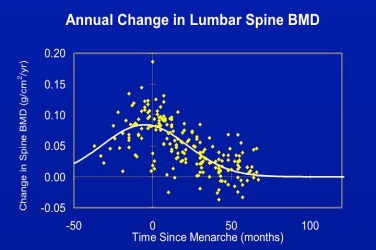
After stratification for months either side of menarche, the peak rate of change for BMD at the lumbar spine was found to be just before menarche, declining rapidly to no change by 60 months post menarche. These findings suggest that optimal PBM and hence optimal adult BMD would not be attained if menarche is delayed due to environmental factors such as low energy density diet. If young athletes such as these go on to enter professional companies, or become professional athletes then optimal, age-matched BMD may never be attained as continued low energy density diet and menstrual dysfunction associated with RED-S may persist. Associated low levels of vital hormones such as insulin like growth factor 1 (IGF-1) and sex steroids impair bone microarchitecture and mineralisation. Thus increasing risk of injury such as stress fracture and other long term health problems. The crucial importance of attaining peak potential during childhood and puberty was described at a recent conference at the Royal Society of Medicine based on life course studies. For example, delay in puberty results in 20% reduction of bone mass.

Graph from study of dancers (Keay et al) showing change in BMD according to time from menarche

slide10

It is concerning that RED-S continues to occur in young athletes, with potential current and long term adverse consequences for health. Young people should certainly be encouraged to exercise but with guidance to avoid any potential pitfalls where at all possible. In my next blog I will delve into the Endocrine mechanisms involved in RED-S: the aetiology and the outcomes.

For further discussion on Endocrine and Metabolic aspects of SEM come to the BASEM annual conference 22/3/18: Health, Hormones and Human Performance

References

Optimal Health: including female athletes! Part 1 Bones Dr N. Keay, British Journal of Sport Medicine

Optimal health: including male athletes! Part 2 Relative Energy Deficiency in sports Dr N. Keay, British Journal of Sport Medicine 4/4/17

Keay N. The modifiable factors affecting bone mineral accumulation in girls: the paradoxical effect of exercise on bone. Nutrition Bulletin 2000, vol 25, no 3. 219-222.

Keay N The effects of exercise training on bone mineral accumulation in adolescent girls. Journal of Bone and Mineral Research. Vol 15, suppl 1 2000.

Keay N, Frost M, Blake G, Patel R, Fogelman I. Study of the factors influencing the accumulation of bone mineral density in girls. Osteoporosis International. 2000 vol 11, suppl 1. S31.

New S, Samuel A, Lowe S, Keay N. Nutrient intake and bone health in ballet dancers and healthy age matched controls: preliminary findings from a longitudinal study on peak bone mass development in adolescent females, Proceedings of the Nutrition Society, 1998

Keay N, Dancing through adolescence. Editorial, British Journal of Sports Medicine, vol 32 no 3 196-7, September 1998.

Bone health and fractures in children. National Osteoporosis Society

Lifetime influences on musculoskeletal ageing and body composition. Lecture by Professor Diana Kuh, Director of MRC Unit for Lifelong Healthy Ageing, at Royal Society of Medicine, conference on Sports Injuries and sports orthopaedics. 17/1/17

Relative Energy Deficiency in sport (REDs) Lecture by Professor Jorum Sundgot-Borgen, IOC working group on female athlete triad and IOC working group on body composition, health and performance. BAEM Spring Conference 2015.

Health and fitness in young people

Young people: Neuromuscular skills for Sport Performance

Many publications report concerns over low exercise levels in young people. At the other end of the spectrum there are potential pitfalls to be avoided for young athletes. Some aspects have been discussed in my previous articles: Exercise and fitness in young people – what factors contribute to long term health? and Optimising Health, Fitness and Sports Performance for young people, below are some updates.

windsurf

Supporting previous publications that exercise in young people improves cognitive and academic performance, it was found that in boys delay in reading skills was associated with high levels of sedentary time combined with low levels of exercise. Low muscle tone, associated with lack of exercise is also proposed as potential inhibitor of learning in children. Lack of physical activity, coupled with unfavourable body composition in young people is linked with adverse outcomes for bone development and cardio-metabolic disease in adults. Now there also appears to be long term consequences for cognitive ability and neuromuscular skills.

For young people already involved in sport training, the same principles apply in that this represents the optimal time in life for development of not only physical fitness such as CV fitness, muscular strength and endurance, but also neuromuscular skills. All these factors are important to enhance sport performance and to avoid injury. The risk of injury is more prevalent in early sport specialisation, so any strategies to minimise injury risk is important. For example, periodised strength and conditioning with neuromuscular training to reinforce the acquisition of a diverse range of motor skills. In other words to combine both health related physical fitness (eg. CV fitness) with skill related fitness (eg. co-ordination). The Pilates style body conditioning which I teach for young people, includes developing flexibility, proprioception, core stability, balance and co-ordination which are applicable for all sports.

Collaboration with coaches, sports clubs, physiotherapists and other health care professionals is required to support young people and their families in optimising health and fitness.

For further discussion on Endocrine and Metabolic aspects of SEM come to the BASEM annual conference 22/3/18: Health, Hormones and Human Performance

References

Optimising Health, Fitness and Sports Performance for young people Dr N. Keay, British Journal of Sports Medicine

Exercise and fitness in young people – what factors contribute to long term health? Dr N. Keay, British Journal of Sports Medicine

Factors impacting bone development

Reading skills in sedentary boys

Muscle tone and leaning in children

Factors impacting bone development

Optimal Heath especially for Young athletes! British Association of Sport and Exercise Medicine

When to initiate integrative neuromuscular training to reduce sports-related injuries and enhance health in youth?

Sports Specialization, Part II: Alternative Solutions to Early Sport Specialization in Youth Athletes

The role of Pilates in facilitating sports performance

Health and Fitness in young people

Recent reports reveal that children in Britain are amongst the least active in the world. At the other end of the spectrum there have been a cluster of articles outlining the pitfalls of early specialisation in a single sport.

Regarding the reports of lack of physical activity amongst young people in Britain, this is of concern not only for their current physical and cognitive ability, but has repercussions for health in adult life. Research demonstrates that young people with low cardiovascular fitness have an increased risk of developing cardiovascular disease in adult life. Conversely, the beneficial effects of weight bearing exercise in prepubescent girls has been shown to enhance bone mineral density accumulation, which will have beneficial impact on peak bone mass. However, as I found in my longitudinal studies, the level of exercise has to be in conjunction with an appropriate, well-balanced diet to avoid relative energy deficiency deficiency in sport (RED-S), which can compromise bone mineral density accumulation.m-running

At the other end of the scale, early specialisation in a single sport does not necessarily guarantee long term success. Rather, this can increase the risk of overuse injury in developing bodies, which in turn has long term consequences. Ensuring that all elements of fitness are considered may be an injury prevention strategy. I agree that injury prevention can be viewed as part of optimising sports performance, especially in young athletes for both the present and in the long term.

Sleep is a vital element in optimising health and fitness, especially in young people who may be tempted to look at mobiles or screens of other mobile devices which delays falling asleep by decreasing melatonin production. Sleep promotes mental freshness and physical elements such as boosting immunity and endogenous release of growth hormone. As Macbeth put it, sleep is the “chief nourisher in life’s great feast”.

A balanced approach to health and fitness should be promoted, with young people encouraged to take part in a range of sporting activities.

For further discussion on Endocrine and Metabolic aspects of SEM come to the BASEM annual conference 22/3/18: Health, Hormones and Human Performance

References

Young athletes’ optimal health: Part 3 Consequences of Relative Energy Deficiency in sports Dr N. Keay, British Association Sport and Exercise Medicine, 13/4/17

Sleep for health and sports performance Dr N. Keay, British Journal Sport Medicine, 7/2/17

Optimising health, fitness and sports performance for young people Dr N. Keay, British Journal Sport Medicine

Telegraph article

Active Healthy Kids global alliance

Poor cardiovascular fitness in young people risk for developing cardiovascular disease 

Sports Specialization in Young Athletes

IOC consensus statement on youth athletic development British Journal Sport Medicine

Optimising Health, Fitness and Sports Performance for young people

Version 2Young people need information in order to make life decisions on their health, fitness and sport training with the support of their families, teachers and coaches.

As discussed in my previous blog anima sana in corpore sano, exercise has a positive effect on all aspects of health: physical, mental and social. The beneficial impact of exercise is particularly important during adolescence where bodies and minds are changing. This time period presents a window of opportunity for young people to optimise health and fitness, both in the short term and long term.

The physical benefits of exercise for young people include development of peak bone mass, body composition and enhanced cardio-metabolic health. Exercise in young people has also been shown to support cognitive ability and psychological wellbeing.

Optimising health and all aspects of fitness in young athletes is especially important in order to train and compete successfully. During this phase of growth and development, any imbalances in training, combined with changes in proportions and unfused growth plates can render young athletes more susceptible to overuse injuries. A training strategy for injury prevention in this age group includes development of neuromuscular skills when neuroplasticity is available. Pilates is an excellent form of exercise to support sport performance.

In athletes where low body weight is an advantage for aesthetic reasons or where this confers a competitive advantage, this can lead to relative energy deficiency in sport (RED-S). Previously known as the female athlete triad, this was renamed as male athletes can also be effected. The consequences of this relative energy deficiency state are negative effects on metabolic rate, menstrual function, bone health, protein synthesis and immunity. If this situation arises in young athletes, then this is of concern for current health and may have consequences for health moving into adulthood.

A well informed young person can make decisions to optimise health, fitness and sports performance.

Link to Workshops

For further discussion on Endocrine and Metabolic aspects of SEM come to the BASEM annual conference 22/3/18: Health, Hormones and Human Performance

References

Optimal Health: Especially Young Athletes! Part 3 – Consequences of Relative Energy Deficiency in Sports Dr N. Keay, British Association Sport and Exercise Medicine 13/4/17

Report from Chief Medical Officer

Cognitive benefits of exercise

Injuries in young athletes

Young people: neuromuscular skills for sports performance

IOC consensus statement\

Exercise and fitness in young people – what factors contribute to long term health? Dr N. Keay, British Journal of Sports Medicine