Menstrual Monitoring
The pros and cons of digital Menstrual Tracking
It is indisputable that having a regular menstrual period is a barometer of internal healthy female hormone choreography [1]. Equivalent to a free monthly medical check.
The question is how can a woman best understand her menstrual cycle? Does the answer lie in Femtech and menstrual tracking? “Digital menstrual tracking risks creating more harm than benefit” is a thought-provoking article in the British Medical Journal 2026 challenging this approach [2].
It may surprise some younger readers that there was a time when we didn’t have the internet, mobile phones, apps, social media, digital monitoring devices. We survived and even thrived! I am not advocating that we should return to the “dark ages” in terms of technology, clearly there are many positives. In biological science and healthcare, the traditional labour intensive and slow pace of research, testing and application of new approaches can be efficiently streamlined using a variety of digital based approaches.
However, for the individual, the vast array of digital monitoring possibilities can be over whelming, pushed by marketing that promises to make you fit and healthy. Why restrict yourself to one monitoring device when you can have many? Surely the more data you have, the better for a positive outcome? Not so. Before you rush out and get the latest health monitoring device/app, it is worth reflecting on the purpose of collecting this data. Having lots of data won’t automatically make you healthier. Just as doing lots of exams won’t automatically make you cleverer. The value of the data depends on whether you have identified the most useful data to help you achieve your objective. You also need to be equipped to interpret the data collected and translate this into actionable strategies to support your desired outcome. Repeating the sequence of collecting targeted data to direct modification, over many successive rounds as a feedback loop, will support better understanding and sequential improvements. In other words, it is important to close the data loop.
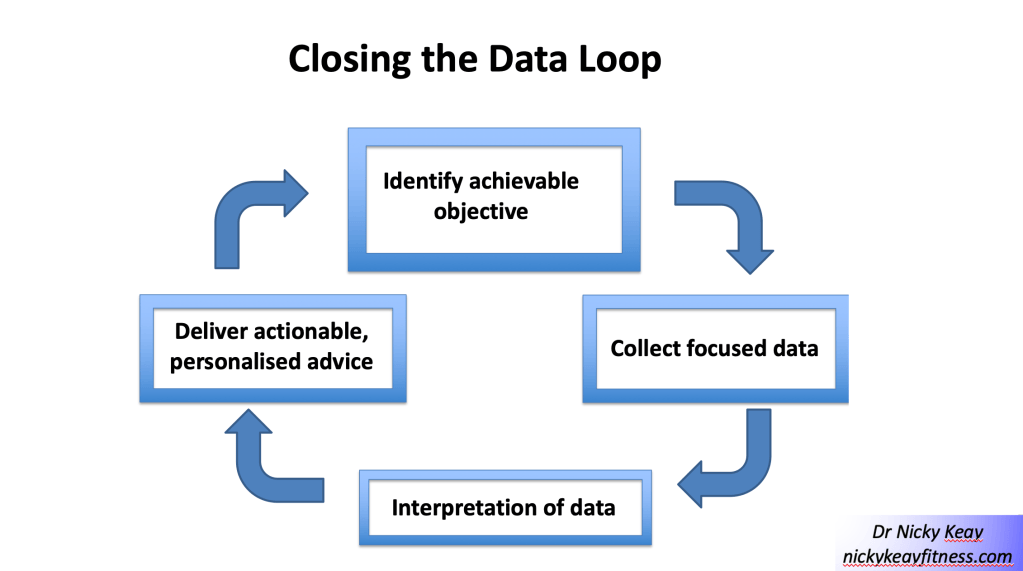
Applying this logic of closing the date loop to digital monitoring of the menstrual cycle, let’s explore what this looks like.
Identifying an achievable objective
Logging your menstrual cycle can potentially raise your awareness and understanding of your cycle. This includes understanding of typical cycle length, predicting when you might expect your next period. Noting any repeating patterns in terms of mood and wellness over the cycle can be informative. For example, some menstrual related issues like premenstrual syndrome (PMS) are diagnosed on the basis of symptoms, not blood tests. PMS is diagnosed on recurring symptoms over at least 3 consecutive cycles, occurring in the 2 weeks before a period and resolving as menstruation starts. In some ways the “old fashioned” pen and paper approach has advantages as you record your personal response to your individual hormone choreography. You do your own detective work, rather than relying on an algorithm to tell you how you should or shouldn’t experience your personal menstrual cycle.
A purported benefit of digital menstrual monitoring apps is to enable you to achieve “cycle synching”. To eat and exercise in certain ways according to an algorithm that is claimed to know exactly where you are in your menstrual cycle, so you can perform to your best. The fundamental flaw in this proposal is that there is no robust evidence that the phase of the menstrual cycle affects performance. This has been demonstrated in athletes, where optimising performance and reducing injury risk is crucial [3]. That is not to say that there may be some individuals where the phase of the cycle can have an impact on performance. Lack of statistical significance does not necessarily translate to lack of clinical significance. Even small differences could make all the difference between a gold and silver medal. Nevertheless, the point is that the only way to identify if you are an individual for whom the menstrual cycle phase does have an impact on how you feel and perform, is to identify this for yourself. You are an individual with your own unique responses to hormones. You are not a statistic in an algorithm.
Interpretation of data
A big problem is that apps will be challenged in predicting something which is inherently variable. We are talking about the phase of the menstrual cycle. The hormone fluctuations over the menstrual cycle are shown as beautiful smooth curves, often with the cycle symmetrically divided into two halves of follicular and luteal phase. In reality this is not what happens.
We published a paper looking in detail at daily hormone fluctuations over the menstrual cycle in 30 ovulating women. The main source of variability in the length of the menstrual cycle was found to reside in the length of the follicular phase, with the length of the follicular phase varying between women [4]. So, counting forward from the first day of the follicular phase (first day of the menstrual period) is not a good starting point to base prediction of menstrual phase . Even in women with regular menstrual cycles, there will be variation of follicular phase length from cycle to cycle. Adding additional information such as changes in mucous and/or LH urine strips to try and pinpoint ovulation can help, but ultimately, a lot of uncertainty remains. Continuous hormone monitoring would improve accuracy of correctly identifying cycle phase.
Although menstrual cycle symptoms can affect quality of life, relying on an algorithm to tell you how you feel/should feel during a particular phase of the menstrual cycle, estimated in an inaccurate way, is not empowering for the woman. Rather this scenario could potentially make a woman question her ability to assess how she is feeling, lose confidence and wonder if there is something wrong with her because her experience dose not match the algorithm output [5]. An algorithm cannot assess your personal e experience to your unique hormone dance.
In the BMJ article it is argued that changes in the menstrual cycle detected on digital monitoring app cannot diagnose the underlying cause. After all, lack of periods (amenorrhoea) is a clinical sign, not a diagnosis. Furthermore, an app will not be able to detect subtle changes in menstrual cycle such as subclinical ovulatory disturbance, a potential precursor to functional amenorrhoea (FHA) as a symptom of relative energy deficiency in sport (REDs) [6]. The risk of REDs can only be assessed in clinical context of an individual’s training load, nutrition, recovery, together with psychological factors. The personal energy availability questionnaire (PEAQ) is an evidence-based questionnaire based on our research, that can be used as an initial screening tool [7].
Delivering actionable advice
The weak evidence base in the provision of appropriate actionable advice by menstrual monitoring apps, can potentially undermine and sometimes even contradict medical advice on the optimal balance of nutrition and exercise. Although an increase in progesterone and relaxin in the luteal phase of the cycle could potentially make collagen weaker and more prone to injury, this should not trigger a universal warning about exercising in the luteal phase of the cycle. In fact, exercise in the luteal phase is recommended by Royal College of Gynaecologists to help with PMS.
The BMJ article raises concern about inadequate privacy. It is reported that some Femtech platforms actively sell menstrual data which could led to app users being exposed to misuse of their health data by employers or state and potential discrimination. The question remains whether the explosion of the Femtech market and commercialisation of women’s health has empowered woman, or contributed to the “worried well” and potentially entrenched sex related stereotypes [8]? Specifically for menstrual monitoring apps, delivering rigid “certainties” can led women to question her own experience of her menstrual cycle and erode self-confidence.
Ultimately the menstrual cycle is an amazing feat of hormone choreography and the menstrual cycle hormones support a multitude of facets of both mental and physical health. The most important thing for each woman to remember is that her cycle and response to hormones are experience of the cycle are personal to her. Logging and tuning into your cycle can be really valuable, but remember that you are not a static nor an algorithm.
References
1 Keay N. Hormones, Health and Human Potential. Sequoia books 2022
2 Lee K, DiMarco M, Reiches M et al. Digital menstrual tracking risks creating more harm than benefit. BMJ 2026; 394:e100858
3 McNulty KL, Elliott-Sale KJ, Dolan E et al. The effects of menstrual cycle phase on exercise performance in eumenorrheic women: a systematic review and meta-analysis. Sports Med 2020; 50:1813-27. pmid:32661839. doi:10.1007/s40279-020-01319-3
4 Burden RJ, Altini M, Ferrer E et al. Measure do not guess: a call to action to end assumed and estimated menstrual cycle phases in research. BMJ Open Sport Exerc Med 2024;10:e002095. pmid:38895644. doi:10.1136/bmjsem-2024-002095
5 MacKrill K, Groom KM, Petrie KJ. The effect of symptom-tracking apps on symptom reporting. Br J Health Psychol 2020; 25:1074-85. doi:10.1111/bjhp.12459
6 Mountjoy M, Ackerman KE, Bailey DM et al 2023 International Olympic Committee’s (IOC) consensus statement on relative energy deficiency in sport (REDs). Br J Sports Med 2023; 57:1073-97. pmid:37752011. doi:10.1136/bjsports-2023-106994
7 Keay N. Br J Sports Med 2025 https://blogs.bmj.com/bjsm/2025/07/25/personal-energy-availability-questionnaire-peaq/
8 Nickel B, Copp T, Mintzes B. The illusion of empowerment: commercializing women’s health in the digital age. Health Promot Int 2026;41: daag074. pmid:42216837. doi:10.1093/heapro/daag074

